What is the difference between calling 811 and hiring a private utility locator?
+
Many people believe calling 811 will locate every underground utility on their property, but that's one of the biggest misconceptions surrounding underground utility locating. When you contact 811, the service notifies participating utility companies that excavation is planned, and those companies send representatives to mark the underground utilities they own and maintain. However, once the utility reaches your property, ownership often changes. Many underground utilities beyond the public connection become the responsibility of the property owner. These are considered private utilities and generally aren't marked through the 811 system. A private utility locating company specializes in finding these privately owned underground utilities using professional equipment such as electromagnetic locators, ground-penetrating radar (GPR), sondes, tracer wire equipment, and other specialized technologies.
What utilities are considered "private"?
+
Many underground utilities beyond the public connection become the responsibility of the property owner. These are considered private utilities and generally aren't marked through the 811 system. Examples include:
- Water service lines from the meter to the house
- Sewer laterals from the building to the public sewer
- Electric service to detached garages, shops, barns, and pools
- Outdoor lighting circuits
- Irrigation systems
- Invisible dog fences
- Private communication and data cables
- Propane lines
- Septic system components
- Private fire lines
- Utilities serving commercial campuses, hospitals, apartment complexes, shopping centers, schools, and industrial facilities
I called 811 and only the gas company marked their line. Why didn't anyone else mark anything?
+
One of the most common misconceptions about 811 is that every utility company comes out and marks something on every ticket. In reality, each utility company only responds if they own underground facilities within your proposed excavation area. For example, if your electric service is supplied by overhead power lines and poles, there may be no underground electrical service for the electric company to mark. If your neighborhood has overhead telephone or cable lines, those companies may also have nothing underground to locate. If your property uses a private well and septic system, there may be no public water or sewer utilities to mark. In these situations, it's completely normal for only one utility company, or even none at all, to place markings.
811 didn't mark anything but the gas line. Why not?
+
811 is the communication link to member utilities. A common misconception is that all utilities are member utilities, which isn't the case. Some providers aren't members of 811 because they don't have equipment or staff trained to locate utilities, these are non-member utilities. Gas, however, is mandated to be a member utility at both the state and federal level, which is often why it's the only one marked. Under Tennessee's Underground Utility Damage Prevention Act, each utility operator is only required to mark its own underground facilities or notify Tennessee 811 that it has none in the area. Utility companies are never responsible for locating privately owned underground utilities, even if they know they exist. See tenn811.com/law for more information.
When should I hire an 811 private utility locating company?
+
Under Tennessee law, anyone planning to excavate with mechanized equipment must notify Tennessee 811 before work begins in most situations. However, the law only requires utility operators to locate and mark their own underground facilities. If your project could encounter privately owned underground utilities that aren't marked through the One-Call system, hiring a private utility locator is the best way to get a complete picture of what's beneath the ground. A private utility locator is recommended anytime your excavation could encounter privately owned underground utilities, including projects such as:
- Installing a fence, deck, or swimming pool
- Digging post holes or planting trees
- Constructing an addition or installing retaining walls
- Trenching for electrical, water, or drainage lines
- Directional boring or parking lot improvements
- Commercial site work, utility repairs, or demolition projects
It's especially valuable at residential properties, commercial properties, schools, hospitals, churches, apartment complexes, shopping centers, industrial facilities, and municipal campuses, since these properties often contain extensive privately owned underground utility systems that fall outside the scope of standard 811 markings.
Can you locate abandoned or unknown underground lines?
+
Often, yes. Unknown or abandoned underground utilities are more common than most property owners realize. While no method can guarantee finding every abandoned or unknown line, professional locating equipment can often detect buried utilities that no longer appear on maps, have been forgotten over time, or were installed without accurate records. Identifying these lines before excavation can help prevent costly surprises, project delays, and potential safety hazards. It's not uncommon to discover abandoned water lines, old gas lines, unused electrical or communication cables, fiber optic conduit, storm drainage systems, sewer laterals, irrigation piping, industrial process piping, or other unknown metallic objects. These utilities may no longer be in service, but they can still pose problems during excavation.
How accurate is 811 private utility locating?
+
Private utility locating is highly accurate when performed by trained professionals using the right equipment and techniques, but no locating method is 100% accurate or capable of finding every underground utility. Factors like utility type, soil conditions, materials, congestion, access points, and the condition of the utility itself all affect accuracy. Metallic water lines, steel gas mains, copper communication cables, and utilities with properly installed tracer wire are generally easier to locate, while plastic water lines without tracer wire, PVC or clay sewer pipe, empty conduit, abandoned utilities, and deeply buried or congested utility corridors are more challenging. The goal isn't to eliminate all uncertainty, it's to provide the most accurate information possible so excavation can proceed more safely and efficiently than digging without knowing what lies below.
How deep can a private utility locator find a buried utility?
+
Depth alone doesn't determine whether a utility can be located. Some utilities buried only a few inches deep can be difficult to locate, while others several feet or more below the surface may be identified successfully. Professional locating equipment doesn't have a fixed depth limit like a metal detector; the ability to locate a utility depends on how well it responds to the locating technology being used. In many cases, deeper utilities actually produce stronger, more consistent signals than shallow utilities in congested areas.
Can private utility locators create maps of what they locate?
+
Yes. We can create detailed utility maps and CAD drawings showing the approximate horizontal location of underground utilities, valuable for planning, engineering, construction, maintenance, and future excavation projects. There's an important distinction between locating and mapping: a locate identifies the approximate location on the ground using paint and flags before excavation, while mapping documents those locations in a permanent format such as CAD drawings, PDF maps, GIS databases, digital site plans, or as-built exhibits. Instead of temporary paint markings that fade or get removed after a few weeks, a permanent utility map reduces future locating costs, improves project planning, prevents utility conflicts, supports future maintenance, and helps preserve institutional knowledge as personnel change. For many commercial properties and public utilities, a utility map becomes one of the most valuable records they own.
Could private utilities be included on my survey if I'm having one performed?
+
Yes, and this is where accuracy can be significantly improved. After underground utilities have been located, a Professional Land Surveyor can collect the location of the marked utilities using survey-grade GPS or conventional surveying equipment, tying them into a known coordinate system for far greater positional accuracy than paint markings alone. Survey-grade utility mapping is commonly used for engineering design, utility relocation, infrastructure improvements, municipal GIS systems, facility management, and construction planning. This isn't common practice, maybe because so few people know it can be done, but having both services offered by the same company makes us a one-stop shop for obtaining this valuable documentation.
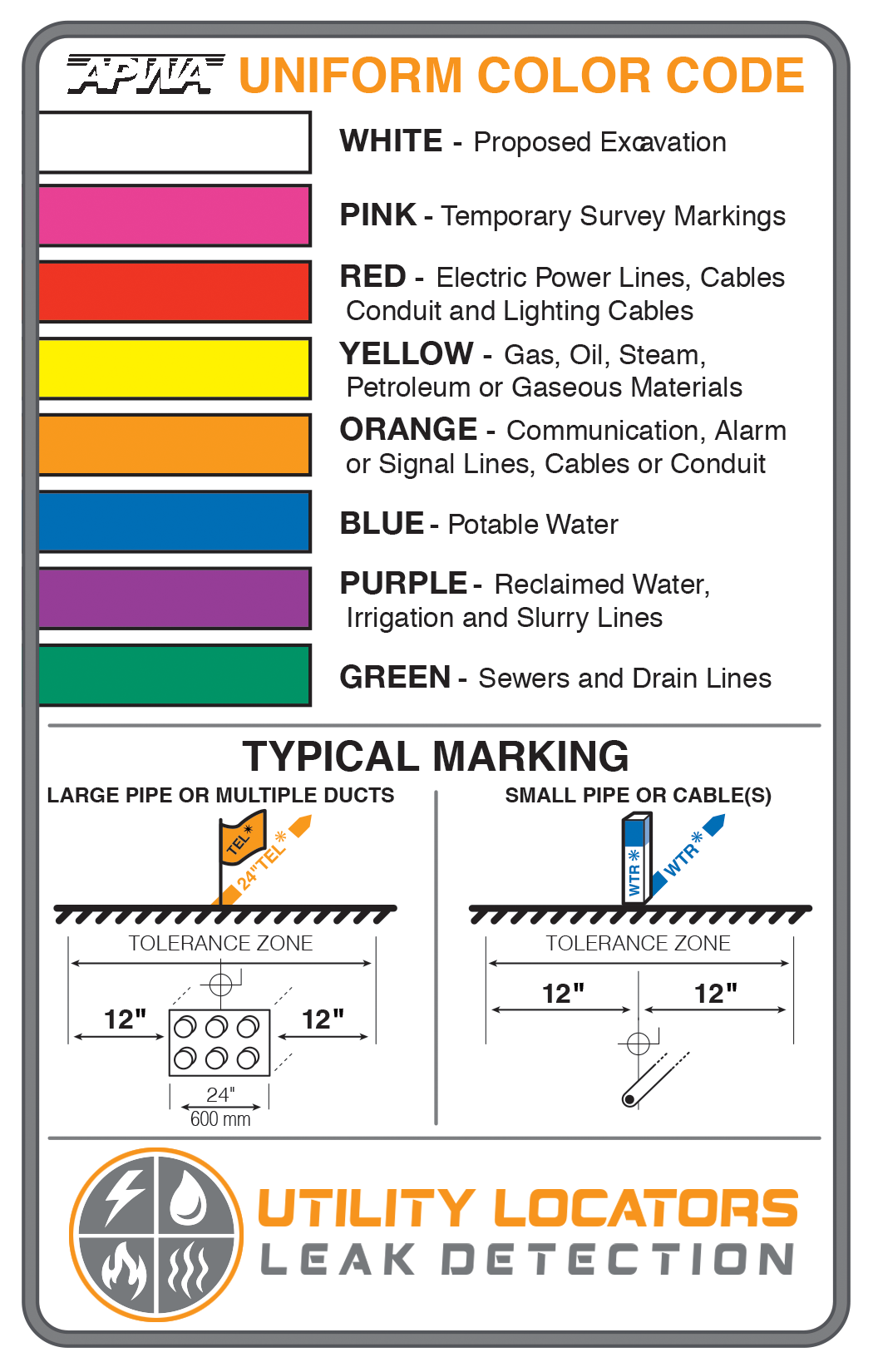
APWA Utility Color Code
